Some projects start with a pattern. Others start with two skeins of yarn that look so lovely together you can’t stop thinking about what they could become.
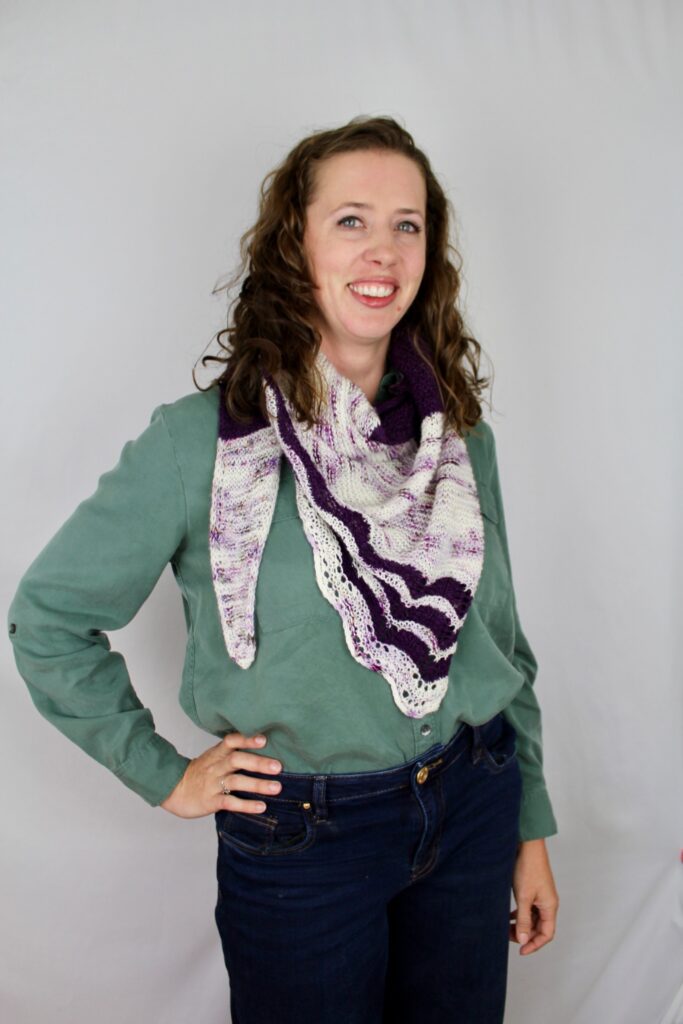
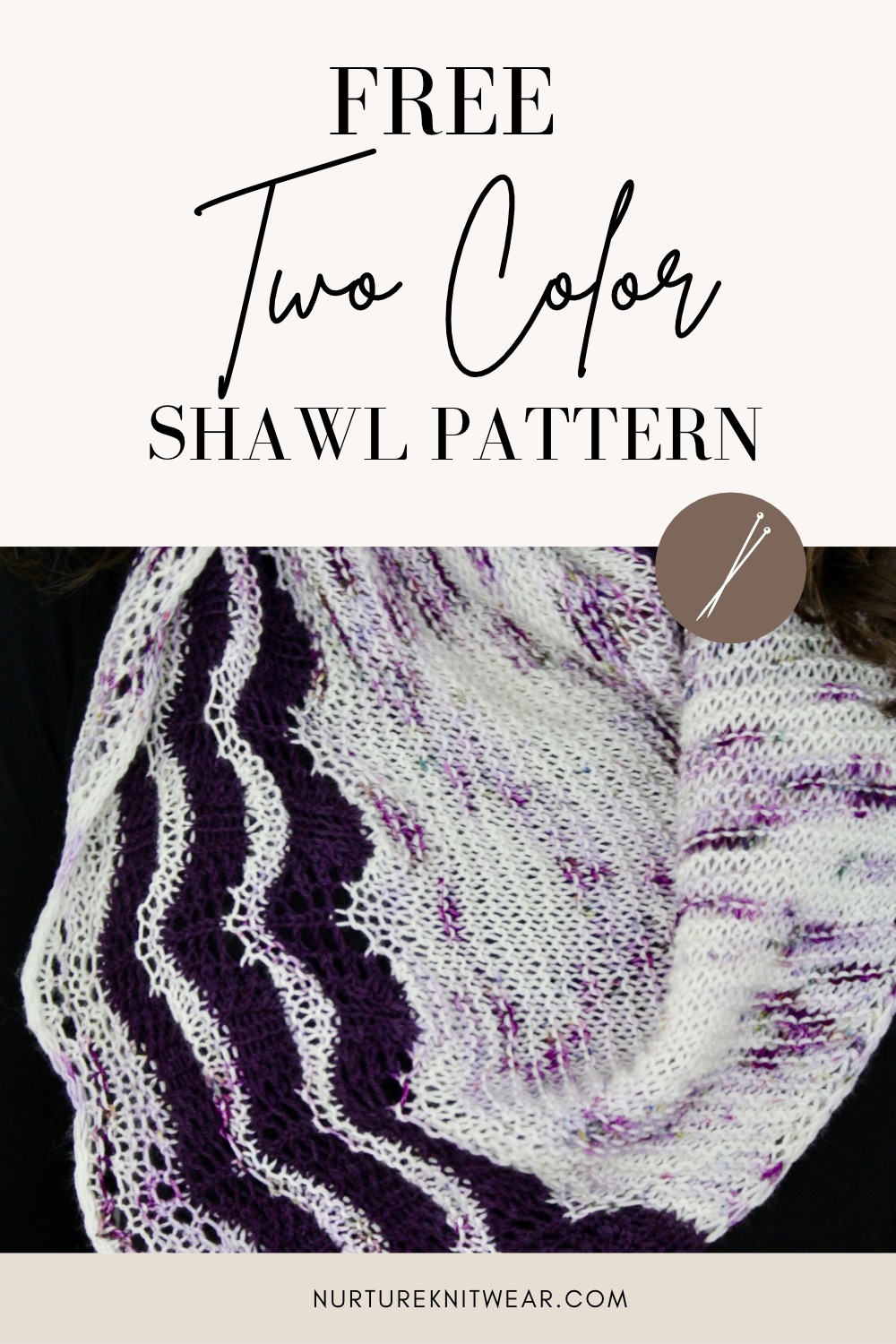
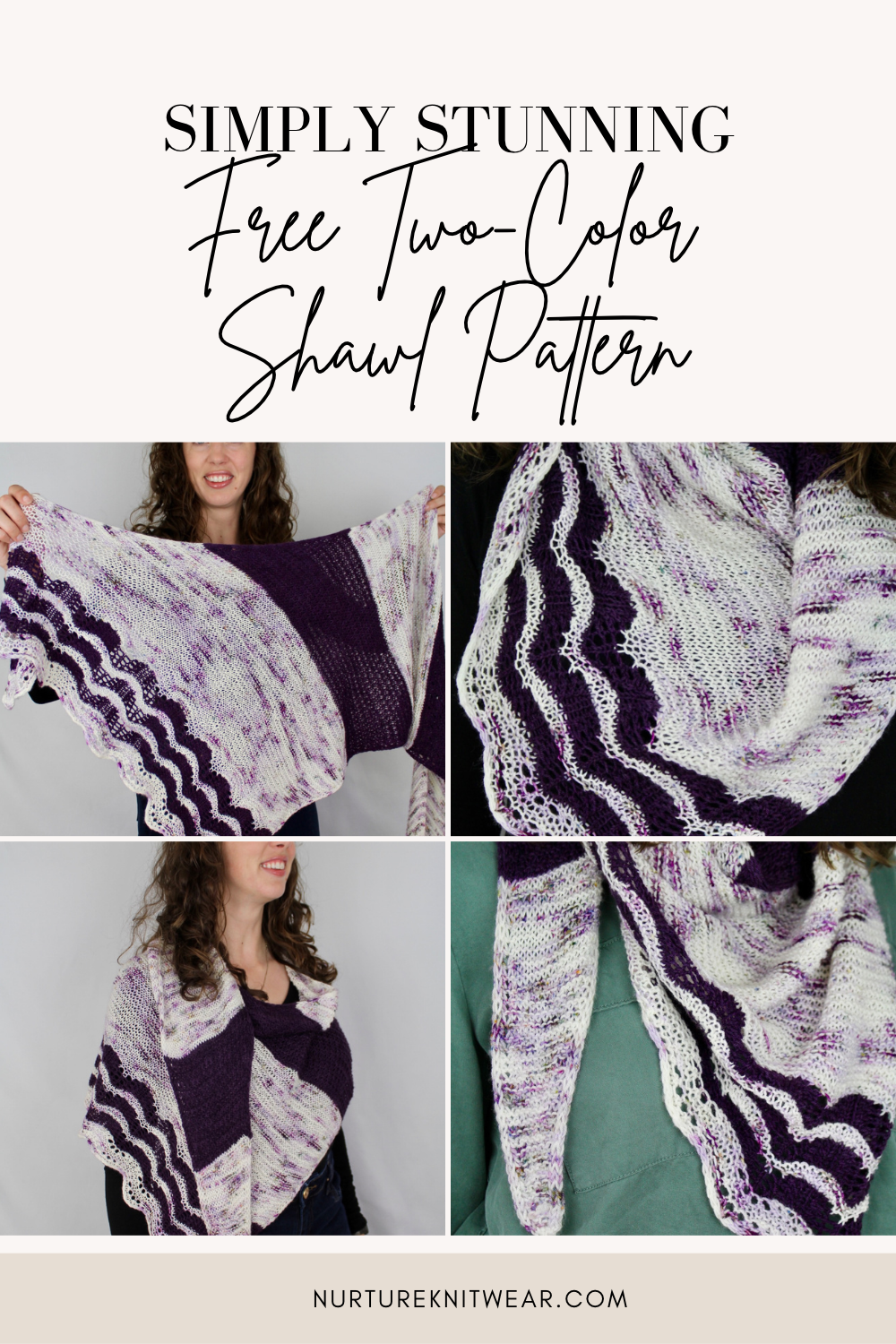
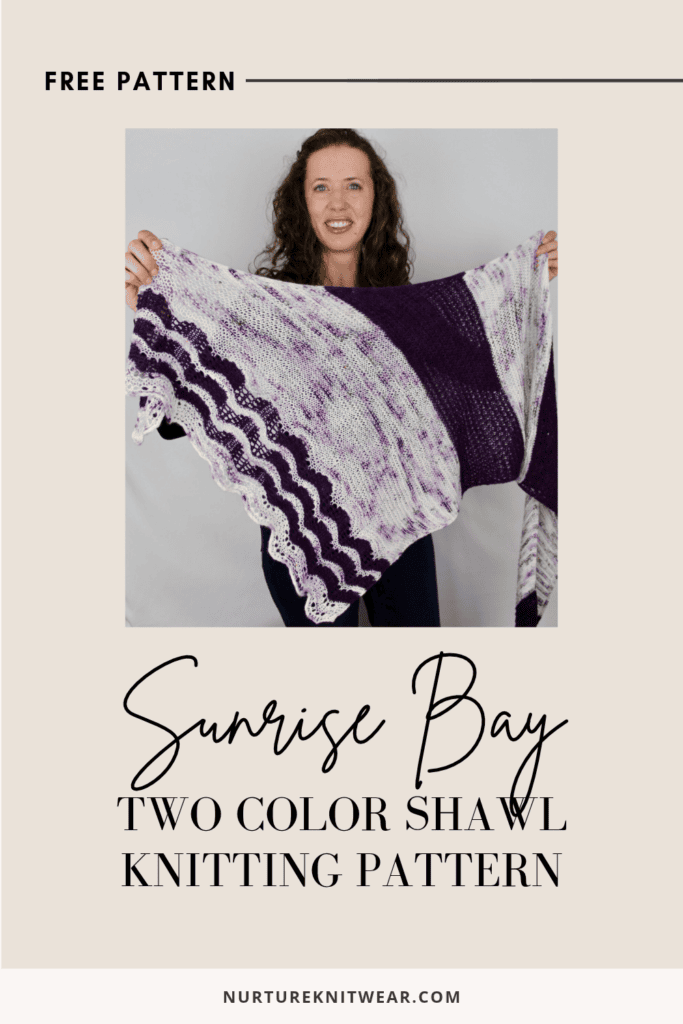
Sunrise Bay is a free two color shawl knitting pattern that gives those special skeins a chance to shine. With its long, sweeping shape and a beautiful lace finish, it’s a shawl you can enjoy choosing colors for, knitting, and finally wrapping around your shoulders.
I first released Sunrise Bay in 2021, and I’m so happy to give it a fresh chapter by sharing the pattern here on the blog for free!
One of my favorite things about yarn festivals is getting to know the people behind the yarn. I’d met Cheryl of Imagine Fiber Arts at several festivals around Michigan, and somewhere along the way, we discovered that we actually live only about fifteen or twenty minutes from each other! All those yarn-filled adventures, and we were practically neighbors.
As we got talking, we realized we had more than yarn in common. Cheryl runs a contracting business, and over the last couple of years, I’ve gotten pretty deep into renovating. So alongside the knitting and color conversations, we had plenty to talk about when it came to fixing things up, making things, and bringing a vision to life. We hit it off, and I’m so glad we did.
Naturally, we decided we needed to work on a project together. After plenty of back-and-forth about patterns and yarn colors—honestly, a pretty delightful way to spend your time—we both fell in love with this combination for Sunrise Bay.
And now that it’s knitted up? I love it even more. The purple is such a beautiful companion to the speckles, giving them room to shine while bringing the whole shawl together. Across that long, sweeping shape, the colors are gorgeous, and the lace at the edge adds just the finishing touch I was hoping for.
Getting to revisit Sunrise Bay with yarn I love and a new local friend has made this release especially sweet. I’m so happy to share it with you.
Yarn Support Note: I requested and received yarn support for this design, which means the yarn company provided the yarn at no cost to me. For a small independent designer, yarn support makes a huge difference—it helps offset the considerable cost of creating and publishing new patterns and allows me to keep bringing new designs to your needles. I’m so grateful to the yarn companies that choose to support my work!
Nurture Knitwear x Imagine Fiber Arts Black Friday Special
November 19–22: Use code MEGAN25 for 25% off anything on the Imagine Fiber Arts website, including clearance yarns. Shop at https://imaginefiberarts.com/ . For Imagine Fiber Arts followers, use code IMAGINE for 25% off all Nurture Knitwear PDF patterns, including Sunrise Bay.
Choosing Two Colors for Your Shawl
The sample shawl is knit in Imagine Fiber Arts 100% Superwash Merino Fingering (437 yards / 100g) — Fresh Cut Lilacs as the main color and Queen of the Night as the contrast. Fresh Cut Lilacs is a white base speckled with lilac and purple flecks; Queen of the Night is a deep, dark purple. You need one skein of each: the pattern takes 320 yards of the main color and 192 yards of the contrast in fingering weight (512 yards total). Picking two colors is where this shawl really comes alive — think in contrast, not in matching. A speckled yarn paired with a solid is a good place to start: the speckle does the color work and the solid gives it room to breathe. That is exactly what happens here — the flecks in Fresh Cut Lilacs pick up the deep purple of Queen of the Night, and the dark purple makes the speckles pop.
Choosing yarn might be half the fun of a two color shawl. This is a lovely opportunity to pull out that special speckled skein and find a companion for it.
For a coordinated pairing, look for a solid or tonal yarn that picks up one of the colors in your speckled skein. You’ll give that shade a little extra attention while letting the other colors add their own personality.
Prefer a bolder look? Try two colors with a stronger difference in lightness or depth. Or choose a quieter pairing for a shawl that slips easily into your everyday wardrobe.
Before you commit, unwind a little of each yarn and lay the strands beside each other. Colors can look surprisingly different together than they do tucked into their skeins, and those few minutes can help you picture the finished shawl.
Whatever direction you choose, make it a combination you’re excited to spend time with. You’ll be seeing plenty of those colors while you knit—and hopefully wearing them for years afterward. If you’d like a little help choosing your pair, my guide to using color in your knitting walks through some approachable color theory.
Which color goes where? The lace and textured stitches appear in the contrast-color sections. Use your solid or tonal yarn as the CC and your speckled or self-striping yarn as the MC so those details can show.
Thank you!
You have successfully joined our subscriber list.
Sunrise Bay Pattern Details
Sunrise Bay is worked flat from a small cast-on, growing through sections of garter stitch, slipped-stitch texture, eyelets, and a wavy lace border. The pattern includes fingering-weight and DK-weight instructions, with optional short rows to adjust the angle.
Finished Measurements
Wingspan: 68″/172 cm Depth: 20″/50 cm
Yarn Requirements
Instructions and quantities are given for fingering (DK) weight. Follow the numbers in parentheses for DK.
Main color (MC): 320 (245) yds/292 (225) m Contrast color (CC): 192 (140) yds/175 (130) m
Suggested Yarn
The sample shawl is knit in Imagine Fiber Arts 100% Superwash Merino Fingering (437 yards / 100g) — 1 skein each of Fresh Cut Lilacs (MC) and Queen of the Night (CC). Fresh Cut Lilacs is a white base speckled with lilac and purple flecks; Queen of the Night is a deep, dark purple. The pattern takes 320 yards of the main color and 192 yards of the contrast in fingering weight (512 yards total). The pattern also works in DK weight (385 yards total) if you prefer a slightly cozier shawl — same two-color idea, same 68 inch x 20 inch size.
Needles & Notions
Needles: US 7/4.50 mm, 24″ circular needles, or size needed to obtain gauge. The suggested needle size is the same for both yarn weights; the shawl is worked flat.
Needle note: I tend toward being a tight knitter, so go down one or two needle sizes if you tend toward looser knitting!
Knitting flat, garter stitch, kfb increases, yarn overs, slipped stitches, knit and purl stitches, k2tog and ssk decreases, lace, and optional wrap-and-turn short rows. If lace is new to you, my guide to yarn overs, k2tog, and ssk explains the stitches you’ll use.
Glossary
BO – bind off CC – contrast color CO – cast on k – knit kfb – knit in the front and back of the same stitch k2tog – knit 2 sts together m – marker MC – main color p – purl pm – place marker rep – repeat rm – remove marker RS – right side sl – slip stitch sm – slip marker ssk – slip 2 sts knitwise one at a time, return sts to the left needle and knit the two sts together through the back loop st(s) – stitch(es) w&t – wrap and turn WS – wrong side wyif – with yarn in front wyib – with yarn in back yo – yarn over
Your free pattern is on its way!
In the meantime, join in the conversation at Nurtured Knitters, our Facebook group! Ask questions, share photos, and join a community made to lift you up!
Pattern Notes
Yardage
Want to stick to only one CC skein in DK weight? Omit the third lace wave and you’re all good!
Blocking & Gauge
I love to give a shawl a good stretch as I wet block and pin it. This adds considerable drape and length no matter what natural fiber you use. Since I take the final gauge after blocking, this makes my during-knitting gauge significantly different than the final gauge. If you want to get a more accurate measure, wet block, stretch, and pin your swatch. However, gauge is not crucial to this project, though it will affect your size and yarn usage. The key is to get fabric you love!
Please Read Before You Begin!
This pattern is free to use here on the Nurture Knitwear website, but please don’t copy, paste, repost, or reproduce the pattern elsewhere. The ads on this site are what allow me to keep offering patterns like this for free. I make less than $1/hour as a designer and that’s before website costs, yarn, photography, tech editing, and all the rest.
If you enjoy having access to free patterns, the kindest thing you can do is read and use them here rather than copying them elsewhere.
And if you hate ads/website use, I always offer the patterns for just a few dollars on Ravelry & Etsy. Thank you for supporting my work and helping me continue to create free knitting patterns.
Sunrise Bay: Free Two Color Shawl Knitting Pattern
Read the notes and choose your yarn-weight version before beginning. Numbers are written as fingering (DK) where both versions are shown.
Section 1
Using MC, CO 1 st.
Row 1 (RS): Kfb – 2 sts.
Row 2 (WS): K across.
Row 3: Kfb, k1 – 3 sts.
Row 4-6: K across.
Row 7: K1, kfb, k1 – 4 sts.
Row 8-10: K across.
Repeat Rows 7-10 one more time – 5 sts.
Row 11: K2, kfb, k across – 6 sts.
Row 12-14: K across.
Row 15: K3, yo, k across – 7 sts.
Row 16-18: K across.
Repeat Rows 15-18 fifteen more times, and then repeat Rows 15 & 16 one additional time – 23 sts. Break MC.
Section 2
Switch to CC.
Row 1-2: K across.
Row 3 (RS): K3, yo, * k1, sl1 wyib, rep from * to last 4 sts, k4 – 24 sts.
Row 4 (WS): K4, * sl1 wyif, k1, rep from * to last 4 sts, k4.
Row 5-6: K across.
Row 7: K3, yo, * k1, sl1 wyib, rep from * to last 3 sts, k3 – 25 sts.
Row 8: K3, * sl1 wyif, k1, rep from * to last 4 sts, k4.
Repeat Rows 1-8 five more times, and then repeat Rows 1 & 2 one additional time – 35 sts. Break CC.
Section 3
Switch to MC.
Row 1: K3, yo, k across – 36 sts.
Row 2-4: K across.
Repeat Rows 1-4 fourteen more times, and then repeat Rows 1 & 2 one additional time – 51 sts.
Want to make the angle a little wider than 90 degrees? I did, so I added a set of short rows every fifth repeat. (Feel free to sail on by if this doesn’t interest you.) To do so, sub in these 4 rows for after every 4 sets of Rows 1-4.
Short Row 1: K3, yo, knit a third of the row (it doesn’t have to be precise, you can eyeball it), w&t.
Short Row 2: K across.
Short Row 3: Knit two-thirds of the row taking care to knit the stitch together with its wrap, w&t.
Short Row 4: K across.
Break MC.
Section 4
Switch to CC.
Row 1-2: K across.
Row 3: K3, yo, * k2, k2tog, yo, rep from * to last 4 sts, k4 – 52 sts.
Row 4-6: K across.
Row 7: K3, yo, * k2, k2tog, yo, rep from * to last 5 sts, k5 – 53 sts.
Row 8-10: K across.
Row 11: K3, yo, * k2, k2tog, yo, rep from * to last 6 sts, k6 – 54 sts.
Row 12-14: K across.
Row 15: K3, yo, k2tog, yo, * k2, k2tog, yo, rep from * to last 5 sts, k5 – 55 sts.
Row 16-18: K across.
Repeat Rows 3-18 two more times – 63 sts. Break CC.
Your free pattern is on its way!
In the meantime, join in the conversation at Nurtured Knitters, our Facebook group! Ask questions, share photos, and join a community made to lift you up!
Section 5
Switch to MC and repeat Section 3 – 79 sts.
Doing the optional short rows? Now sub in the 4 Short Rows after every 2 sets of Rows 1-4.
Fingering weight ONLY:
Break MC. Proceed to Section 6.
DK weight ONLY:
Row 1: K3, yo, k across – 80 sts.
Row 2: K across.
Row 3: K3, yo, k across – 81 sts.
Row 4: K to last 3 sts, yo, k3 – 82 sts.
Rep Row 3 & 4 four more times – 90 sts. Skip to Section 8.
Section 6
Switch to CC and repeat Section 2 – 91 sts. Break CC.
Section 7
Switch to MC.
Row 1: K3, yo, k across – 92 sts.
Row 2-4: K across.
Repeat Rows 1-4 fourteen more times – 106 sts.
Row 5 (RS): K3, yo, k across – 107 sts.
Row 6 (WS): K to last 3 sts, yo, k3 – 108 sts.
Repeat Rows 5 & 6 three more times – 114 sts.
Section 8
Switch to CC. (For this last section, where the color switches are closer together, you can choose to break the yarn at each color switch or carry it up the side!)
Row 1 (RS): K3, yo, pm, * [k2tog] twice, [yo, k1] three times, yo, [ssk] twice, k1, rep from * to last 3 sts, k3 – 115 (91) sts.
Row 2 (WS): K3, p to last 3 sts, yo, k3 – 116 (92) sts.
Row 3: K3, yo, k to m, sm, * [k2tog] twice, [yo, k1] three times, yo, [ssk] twice, k1, rep from * to last 3 sts, k3 – 117 (93) sts.
Rows 4-8: Repeat Rows 2 & 3 two more times, and then repeat Row 2 one additional time – 122 (98) sts. Remove m.
Switch to MC.
Row 9: K3, yo, k across – 123 (99) sts.
Row 10: K to last 3 sts, yo, k3 – 124 (100) sts.
Rows 11 & 12: Repeat Rows 9 & 10 one more time – 126 (102) sts.
Repeat Rows 1-12, including color switches, two more times – 150 (126) sts. Break CC. Continue in MC.
Row 13: K3, yo, pm, * [k2tog] twice, [yo, k1] three times, yo, [ssk] twice, k1, rep from * to last 3 sts, k3 – 151 (127) sts.
Rows 14-18: Repeat Row 10 one time, then repeat Rows 9 &10 two more times – 156 (132) sts.
DK weight ONLY:
Skip to BO.
Fingering weight ONLY:
Row 19: K3, yo, k to m, sm, * [k2tog] twice, [yo, k1] three times, yo, [ssk] twice, k1, rep from * to last 3 sts, k3 – 157 sts.
Rows 20-22: Repeat Row 10 one time, then repeat Rows 9 &10 one more time – 160 sts.
Both yarn weights resume. BO loosely in knit st.
Finishing
Soak in lukewarm water mixed with a bit of wool wash (if you like) for at least 15 minutes. Gently squeeze out water—do not twist. Pin to mats or other blocking surface—taking care to pin each point of the waves along the BO edge. Let dry completely.
Unpin and enjoy!
Make Sunrise Bay Your Own
One of my favorite parts of sharing a pattern is imagining all the different shawls it will become. Cheryl and I fell in love with purple and speckles, but yours might be soft and quiet, bright and playful, or built around a skein you’ve been saving for just the right project.
Whatever colors find their way onto your needles, I hope you enjoy watching them come together. There’s something so satisfying about reaching that last lace wave, opening everything up in blocking, and finally getting to wrap yourself in the shawl you made.
What two colors would you put together? Tell me in the comments below—I’d love to hear what you’re dreaming up for your Sunrise Bay!
If you share photos of your Nurture Knitwear projects, please be sure to tag @nurtureknitwear and use the hashtags #nurtureknitwear and #sunrisebayshawl.