You know that one sweater in your closet—the one that always feels just right? The one you reach for when the first signs of fall creep in, when you’re heading to a coffee shop or curling up with a book, when you’re running errands or meeting friends. It goes with everything. It fits just how you like. You feel like you when you wear it.
That’s the magic I hope knitters find with Elderwild, the first design in my Wild series—and now, for the first time, it’s available to read for free right here on my blog.
This post introduces you to the Elderwild sweater knitting pattern, explains the thought behind the Wild series, and explores how this sweater can be customized to fit your shape, style, and lifestyle. If you’re looking for a free knit sweater pattern for beginners that’s both versatile and wearable, you’re in the right place.
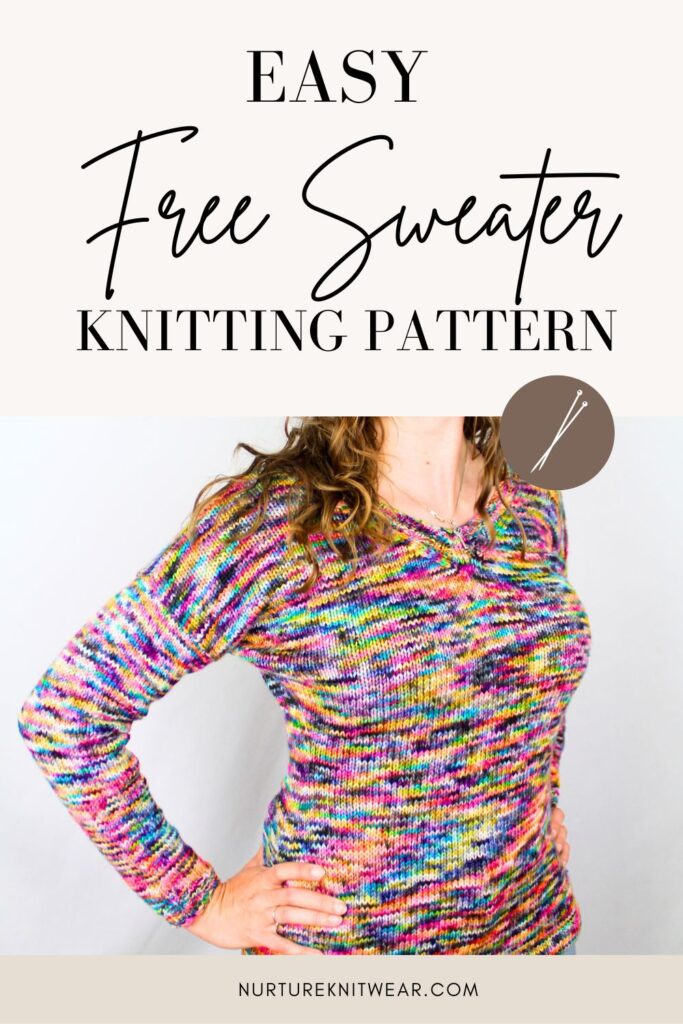
- What Is Elderwild? A Free Knit Sweater Pattern for Beginners with Built-In Modifications
- Meet the Wild Series: Sweaters That Actually Fit and Flatter
- Custom Fit, Made Easy: Why Elderwild Is the Pattern I Keep Coming Back To
- Knit It Your Way: Elderwild Encourages Modification at Every Step
- Why I’m Sharing This Free Knit Sweater Pattern for Beginners
- What You’ll Need to Knit Elderwild
- Yarn Spotlight: Merinosaurus Worsted in Mastodon
- Glossary for Free Beginner-Friendly Sweater Knitting Pattern
- Elderwild Schematic
- Notes for Your Perfect Fit
- Get It Here: Free Knit Sweater Pattern for Beginners!
- Hem
- Body
- Armhole Increases
- Armhole Division
- Neckline Division
- Right Front
- Short Row Shoulder Shaping
- Right Front BO
- Left Front
- Short Row Shoulder Shaping
- Left Front BO
- Back
- Neckline Division
- Right Back Shoulder
- Short Row Shoulder Shaping
- Right Back BO
- Left Back Shoulder
- Short Row Shoulder Shaping
- Left Back BO
- Collar
- Sleeves (Make 2)
- Cuff
- Ready to Cast On this Free Knit Sweater Pattern for Beginners?
What Is Elderwild? A Free Knit Sweater Pattern for Beginners with Built-In Modifications
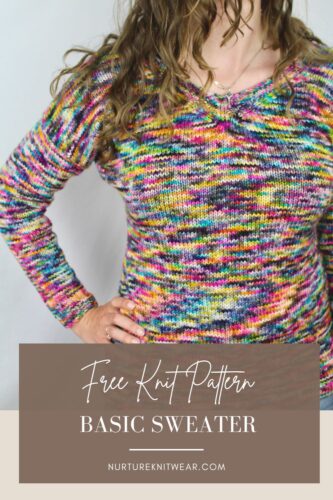
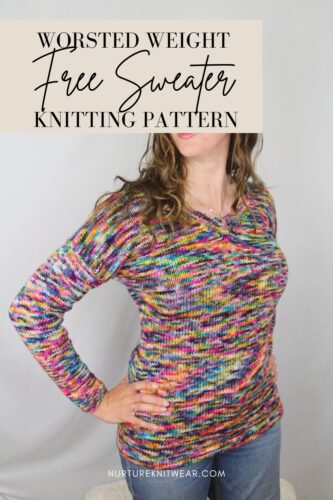
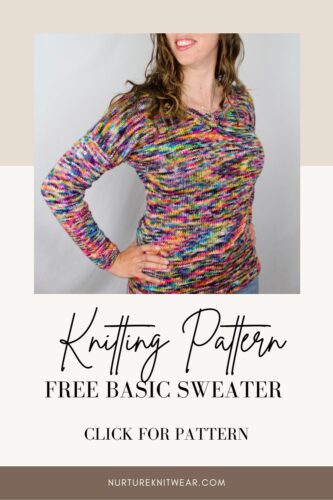
Elderwild is a modified drop-shoulder pullover knit in the round from the bottom up. It features stockinette stitch throughout, a folded hem and cuffs for a polished look, and a mid-depth V-neck finished in classic 2×2 ribbing.
At first glance, Elderwild looks like a neutral, everyday sweater—something you’d see in a curated capsule wardrobe or a thoughtfully packed carry-on. But as you dig into the pattern, you’ll see it’s anything but basic.
Like all patterns in the Wild series, Elderwild is designed to mold to you, not the other way around. There are built-in instructions and notes throughout for modifying:
- Sleeve length
- Body length
- Waist shaping (add it or skip it)
- Shoulder shaping (included, but optional)
- Neckline customization
So whether you prefer a cropped look with bracelet-length sleeves or a longline sweater to wear with leggings, Elderwild gives you the flexibility to make the sweater you actually want to wear—not the one you feel like you have to settle for. It’s a perfect free knit sweater pattern for beginners who want guidance and room to experiment.
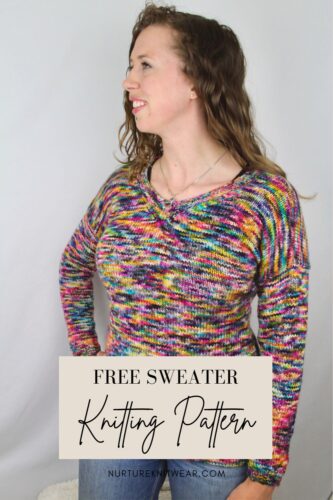
Meet the Wild Series: Sweaters That Actually Fit and Flatter
Elderwild is the first sweater in the Wild series, a group of thoughtfully designed patterns built around the same core idea: helping women build a wardrobe full of go-to sweaters.
The inspiration? I wanted to make garments that truly fit—not just in the technical sense, but in the emotional one. The kind that you love to wear, that reflect your style and flatter your body, that feel like comfort and confidence all rolled into one.
That’s a tall order, especially with knitting patterns, which can sometimes feel one-size-fits-all or lack the nuance needed to flatter a range of body types. That’s why I made modification the heart of each Wild series design.
Instead of asking knitters to adapt a rigid template, these patterns are built with flexibility in mind. Clear instructions and supportive notes make it easy for you to alter your sweater to fit your body and preferences.
Want to add bust darts? Skip waist shaping? Adjust the V-neck to be higher or lower? Elderwild shows you how.
This approach is all about empowerment: helping knitters—especially newer ones—make sweaters that feel like themselves. That’s why Elderwild is more than just a free knit sweater pattern for beginners—it’s a stepping stone to creating garments that really work for you.
Custom Fit, Made Easy: Why Elderwild Is the Pattern I Keep Coming Back To
I designed Elderwild to be the kind of sweater I’d wear constantly. Not because it’s flashy or trendy, but because it’s easy, flattering, and works with everything.
The base design has:
- A mid-depth V-neck, which flatters without feeling too open
- A stockinette body, giving the fabric clean lines and easy drape
- A modified drop shoulder, which gives a soft, casual silhouette
- Folded hems and cuffs, a small detail that adds a lot of polish
- Neutral color choices, to make it endlessly pairable
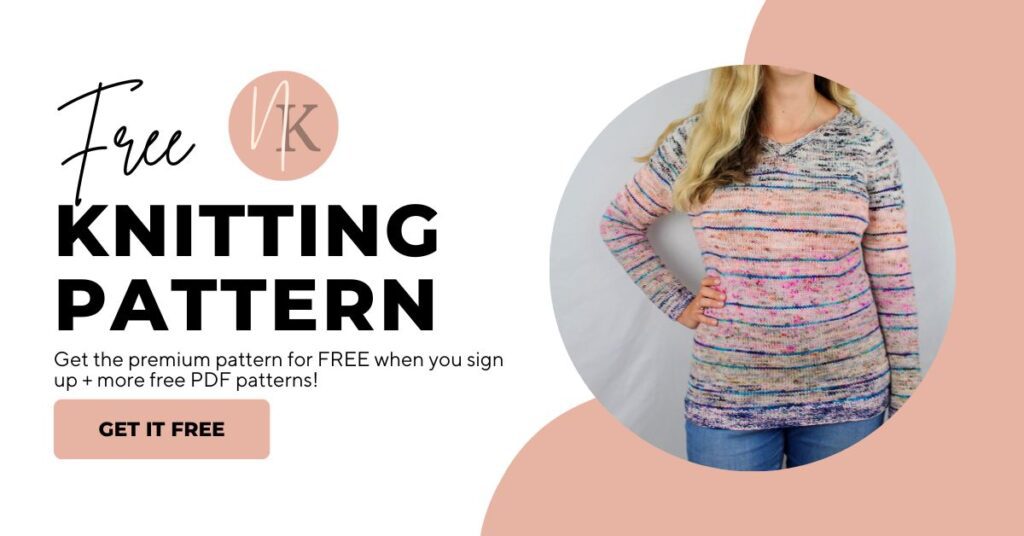
But what really makes Elderwild special is how adaptable it is. The same pattern has produced short and slouchy sweaters, long tunic-style pullovers, sweaters with bold stripes, sweaters with delicate necklines, and everything in between.
Whether you want your sweater fitted or boxy, cropped or tunic-length, Elderwild is the framework—and your creativity does the rest. If you’re dipping your toes into garment knitting, this free knit sweater pattern for beginners gives you room to explore without overwhelming you.
Knit It Your Way: Elderwild Encourages Modification at Every Step
So often, knitters are told to make changes to suit their preferences—but aren’t given the tools or confidence to do so. Elderwild tries to change that.
Inside the pattern, you’ll find optional instructions and supportive notes to walk you through:
Adjusting Sleeve and Body Lengths
Want bracelet-length sleeves? Or extra long sleeves to tuck your hands into on chilly days? It’s easy to adjust them within the pattern framework. The same goes for the body length—whether you’re a cropped-over-dresses type or a cozy-leggings-and-sweater person.
Adding or Skipping Waist Shaping
This is a big one! Some knitters love a gently tailored fit, while others prefer a straighter silhouette. Elderwild includes clear guidance on where to add shaping for the waist—and how to skip it if that’s not your style.
Modifying the Neckline
The pattern comes with a mid-depth V-neck (not too deep, not too high), but you’ll also find notes on adjusting the neckline to better suit your shape and taste. Want a higher neckline or more open V? You’re covered.
Shoulder Shaping Options
Shoulder shaping can make a sweater look and feel more tailored—especially on women with narrow or sloping shoulders. Elderwild gives you the option to include that shaping or keep the shoulder construction simple and relaxed.
These built-in supports make Elderwild an ideal free knit sweater pattern for beginners—you can follow the basic version exactly or test out gentle customization without fear.
Why I’m Sharing This Free Knit Sweater Pattern for Beginners
Starting today, the full Elderwild pattern is available to read for free right here on my blog.
I know firsthand how meaningful it is to make and wear a sweater that really fits—not just your body, but your sense of style. And I want to make that kind of joy and confidence accessible to more knitters.
That’s why I’m opening up the pattern—not as a PDF download, but as a fully viewable blog post you can follow right on the page.
If you’d like a downloadable, ad-free version of the pattern, that’s still available for purchase on Ravelry and Etsy. But the full instructions are now available to view freely online—no paywall, no email signup.
If you’ve been looking for a free knit sweater pattern for beginners that respects your skill and encourages you to stretch it, Elderwild might be the one.
What You’ll Need to Knit Elderwild
Size:
1 (2, 3, 4, 5) [6, 7, 8, 9]
Hip Circumference: 30 (34, 38, 42, 46) [50, 54, 58, 62]”/76 (86.5, 96.5, 106.5, 117) [127, 137, 147.5, 157.5] cm
Chest Circumference: 40 (44, 48, 52, 56) [60, 64, 68, 72]”/101.5 (112, 122, 132, 142) [152.5, 162.5, 172.5, 183] cm
Note for fit: For this sweater, you’ll be looking to find a hip circumference close to that of your typical preferred bust circumference.
Yarn:
800 (900, 990, 1095, 1195) [1310, 1415, 1530, 1615] yds/730 (825, 905, 1000, 1095) [1200, 1295, 1400, 1475] m of heavy worsted weight yarn
Note: If worsted is not available in your area, I would substitute an Aran weight yarn for this design.
Yarn Recommendation:
Harrisville Designs Highland (100% Virgin Wool) 200 yds/180 m, 100 g – 4 (5, 5, 6, 6) [7, 8, 8, 9] skeins in Walnut
Needles & Notions:
US 9/5.5 mm & US 7/4.5 – 32”/80 cm circulars and DPNs or Magic Loop – preferred method of small circumference knitting (or needles needed to obtain gauge!)
Stitch markers, tapestry needle, spare cable or stitch holder
Gauge:
16 sts & 26 rounds = 4”/10 cm in stockinette, with the larger needle, after blocking
Concentration Level:
Low – This pattern is 90% stockinette in the round with some excellent, yet simple details–we’re talking TV knitting at it’s finest.
Techniques to Indulge In:
Provisional CO (optional)
Folded Hem (optional)
Waist Shaping (optional)
V-neck Shaping (optional)
Make sure to swatch—especially if you’re planning to customize fit or make major changes. Even as a free knit sweater pattern for beginners, Elderwild will benefit from a little prep work.
Yarn Spotlight: Merinosaurus Worsted in Mastodon
If you want to add a little roar to your next sweater, Merinosaurus Worsted from Knitty Gritty is the way to go. This playful, dino-themed yarn is 100% superwash merino wool with a smooth 3-ply construction that gives it a sleek, bouncy feel and excellent stitch definition—perfect for showing off Elderwild’s clean stockinette and crisp V-neck ribbing.
It’s a true worsted weight, so it knits up into a cozy fabric without feeling bulky. Each 100g hank packs in 215 yards, giving you generous yardage for all your sweater-knitting adventures. And can we talk about that name? Merinosaurus! Honestly, how could you not love telling people what you’re knitting with?
The Mastodon colorway brings the drama with a deep, rich tone that’s versatile enough for everyday wear but bold enough to stand out. Whether you’re going classic or making a quiet statement, this shade hits the sweet spot.
Fun, functional, and a little bit fierce—Merinosaurus Worsted is ready to stomp into your project bag.
Glossary for Free Beginner-Friendly Sweater Knitting Pattern
BO – bind off
BOR – beginning of round
CC – contrast color
CDD – centered double decrease – slip 2 sts knitwise at the same time (needle goes into the second st first and the two sts are pulled off at the same time. Knit the third st. Pass the first two sts over the third st as if to BO.
CO – cast on
k – knit
k2tog – knit 2 sts together
KFSB – knit front, slip back – knit the st, but do not remove from the needle, instead of knitting the back as for a KFB, slip the back of the st to be knit the next round
LLI – left lifted increase – Using the lefthand needle, pick up the stitch below the stitch just knit on the righthand needle. Knit the stitch.
MC – main color
m – marker
p – purl
pm – place marker
rep – repeat
rm – remove marker
RLI – right lifted increase – Using the righthand needle, pick up the stitch below the next stitch on the lefthand needle and place it on the lefthand needle. Knit the stitch.
st(s) – stitch(es)
ssk – one at a time, slip the next 2 sts knitwise; return the sts to the lefthand needles, and knit them together through the back loops
ssp – one at a time, slip the next 2 sts knitwise; return the sts to the lefthand needles, and purl them together through the back loops
Stockinette Stitch (SS) – Flat
RS Row: K across.
WS Row: P across.
2/2 Ribbing – In the round
Row 1: K2, p2 around.
When instructed to “work ribbing” that means that you knit the knits and purl the purls.
Elderwild Schematic
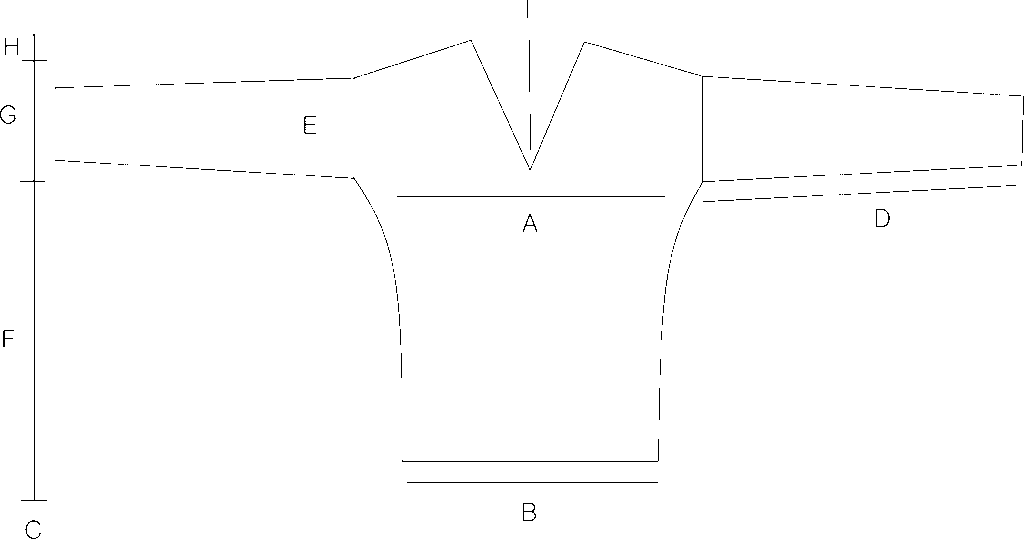
A – Bust Circumference – 40 (44, 48, 52, 56) [60, 64, 68, 72]”/101.5 (112, 122, 132, 142) [152.5, 162.5, 172.5, 183] cm
B – Hips – 30 (34, 38, 42, 46) [50, 54, 58, 62]”/76 (86.5, 96.5, 106.5, 117) [127, 137, 147.5, 157.5] cm
C – Full Length – 24”/61 cm
D – Sleeve Length – 16.25 (16.5, 16.5, 17, 17) [17.5, 17.5, 18, 18]”/41.5 (42, 42, 43, 43) [44.5, 44.5, 45.5, 45.5] cm
E – Upper Arm Circumference – 13 (13.5, 14, 15, 16.5) [18.5, 20, 21.5, 21.5]”/33 (34.5, 35.5, 38, 42) [47, 51, 54.5, 54.5] cm
F – Hem to Armhole – 15 (14.75, 14.5, 14, 13.25) [12.25, 11.5, 10.75, 10.75]”/38 (37.5, 37, 35.5, 33.5) [31, 29, 27.5, 27.5] cm
G – Armhole Depth – 6.5 (6.75, 7, 7.5, 8.25) [9.25, 10, 10.75, 10.75]“/16.5 (17, 18, 19, 21) [23.5, 25.5, 27.5, 27.5] cm
H – Shoulder Drop – 1”/2.5 cm
I – Neck Drop – 5 (5.25, 5.5, 6, 6.75) [7, 7, 7, 7]”/12.5 (13.5, 14, 15, 17) [18, 18, 18, 18] cm
Notes for Your Perfect Fit
Hem
This design is worked with a folded hem. There are several different ways to create this effect:
- You can begin the Hem with a Long Tail CO. On Row 13, you would pick up the purl bumps and knit the front and back together
- Or you can work a Provisional CO to have live stitches to knit together on Row 13. There are multiple types of Provisional COs, such as a CO using waste yarn and crochet hook or using Judy’s Magic CO. (I chose to try out the Provisional CO using Judy’s Magic CO and loved it!)
Any of these options will work or if you’re not a fan of the Hem, you swap out it out for 7 rounds of 2/2 ribbing.
Fit
You can choose the hip circumference that is closest to your natural bust size or a chest circumference that adds about 10”/25 cm of positive ease to your chest.
The body is knit straight up (unless you choose to do the waist shaping below) to 2.5”/6.5 cm below the Armhole Division Round, at which point the armhole increases begin. This is a good time to try it on and make sure the length is just right for you! After attaching an extra cord, hold the live stitches up to the middle/underside of your bust (the 2.5”/6.5 cm will occur as you are knitting up the chest) and see if you like where hem hits you—then add or subtract length accordingly. To make it cropped, subtract 5”/12.5 cm. To make it tunic length, add 7”/17.5 cm.
Waist Shaping
Waist shaping can provide the look of hourglass curves (whether you’ve got them or not!). Though waist shaping is not typically worked on drop-shoulder garments, I always like options! Below is my recommendation for 3”/7.5 cm of waist shaping. Each Decrease/Increase Round changes the size by 1”/2.5—so you can alter the size by adding or subtracting round pairs until you get the perfect size for you.
Knit in the round to 1.5”/3.5 cm below your natural waist. Use the Armhole Increase Set Up Round (in pattern) to place your markers. Work the Decrease Round below every 4th round 3 times.
Decrease Round: * K1, ssk, k to last 3 sts before m, k2tog, k1, rep from * 1 time.
Knit around for 1”/2.5 cm. If you have space before Armhole Increases, work the Increase Round below every 4th round 3 times. (If you don’t have space, work Increase Round every 2nd round.)
Increase Round: * K1, LLI, k to 2 sts before m, RLI, k1, rep from * 1 time.
Resume body instructions.
Spare Cable
I love using a spare cable for interchangeable needles to hold my sts for armhole and neckline divisions because it’s so easy! Simply connect the two cables at the point where you want place sts on hold and slide through the number of sts needed to hold. At this point you can place stoppers on the cord or use a longer cord and connect its two ends with a connector to form an O (I love this because it adds no weight!).
Neck Shaping/Collar
Want a scoop neck instead of a V? Instead of working the Neckline Division Row 1, work this row:
Row 1 (RS): K26 (29, 32, 35, 38) [42, 46, 49, 53], BO 27 (29, 31, 33, 35) [35, 35, 37, 37], k to end.
Skip Rows 1 & 2 for the Right Front and Left Front. Work Rows 3 & 4 four times. Your stitch count will now match. Resume knitting the pattern at “Continue knitting SS…”
Do not follow instructions for Collar, instead pick up a multiple of 4 sts and work 2/2 ribbing in the round for 7 rounds. BO all sts using Kitchener BO or preferred stretchy BO.
Stretchy BO for 2/2 Ribbing
I love using the Kitchener BO for 2/2 ribbing, aka the Tubular BO or the Invisible BO. It takes a little more time than binding off in pattern, but provides a beautiful finish to your ribbed edging. If you’d like to see it in action, check out my YouTube video: Invisible Kitchener Bind Off for 2/2 Ribbing on the Nurture Knitwear channel.
Shoulder BO Options
You can choose from one of the 3 shoulder BO options, and then stick you’ll stick to those instructions for all shoulder BOs. Those options are:
Kitchener Graft: Once all 4 shoulders are complete, you will use the Kitchener Stitch graft to sew the right and left sides together in a way that mimics the knit stitch. This is the most invisible, though not as strong as the other 2 options.
3-Needle: Once all 4 shoulders are complete, you will place any stitches on a stitch holder back onto a live needle and then flip the sweater inside out. You will align the needles for one side with one needle in front and the other in the back. Knitting a stitch from the front needle together with a stitch from the back needle, you will BO across the row.
Seamed: You will BO each shoulder as you complete it. Once all 4 shoulders are complete, you will seam each side together using the Mattress Stitch.
Sleeve Length
Want short sleeves instead? Work decreases at the same rate for 1”/2.5 cm, then work a 2/2 ribbing for 1.25”/3 cm.
Prefer 3/4-length sleeves? Work decreases at the same rate recommended, but subtract 6” from your size’s sleeve length. Work cuff as described or work a 2/2 ribbing for 1.25”/3 cm.
Sleeve Width
The sleeves are intended to be quite fitted along the biceps. If you like a little more space in your sleeves then follow the sleeve pick up and decrease instructions for the next size up!
Get It Here: Free Knit Sweater Pattern for Beginners!
Hem
Using smaller needle, CO 120 (136, 152, 168, 184) [200, 216, 232, 248] sts—see notes for CO options. Pm and join in the round, taking care not to twist the stitches.
Knit around for 6 rounds. Switch to larger needles, and knit around for 6 rounds. Fold the CO edge behind the live stitches so that stockinette is showing. If Long Tail CO was used, pick up the purl bumps. If the crochet Provisional CO was used, transfer to needles now. To join, knit 1 st from the front needle together with 1 st from the back needle, around.
Body
Knit around until body reaches 15 (14.75, 14.5, 14, 13.25) [12.25, 11.5, 10.75, 10.75]”/38 (37.5, 37, 35.5, 33.5) [31, 29, 27.5, 27.5] cm from the CO edge.
Armhole Increases
Set Up Round: K 60 (68, 76, 84, 92) [100, 108, 116, 124], pm, k around.
Round 1: * K1, LLI, k to 1 st before m, RLI, k1, rep from * 1 time – 124 (140, 156, 172, 188) [204, 220, 236, 252] sts.
Round 2: K around.
Rounds 3-20: Rep Rounds 1 & 2 nine more times – 160 (176, 192, 208, 224) [240, 256, 272, 288] sts.
Armhole Division
Round 1: K to m. Place remaining 80 (88, 96, 104, 112) [120, 128, 136, 144] sts on spare cable or stitch holder—these stitches will now be referred to as Back. Live sts are Front.
Round 2 (WS): P across.
Sizes – (-, -, -, -) [6, 7, 8, 9] ONLY
Work SS for – (-, -, -, -) [.75, 1.5, 2.25, 2.25]”/- (-, -, -, -) [2, 4, 5.5, 5.5] cm, ending after completing a Row 2.
All Sizes Resume.
Neckline Division
Row 1: K39 (43, 47, 51, 55) [59, 63, 67, 71], BO 1, k to last 3 sts, k2tog, k1 – 78 (86, 94, 102, 110) [118, 126, 134, 142] sts.
Options: 1) Place the 39 (43, 47, 51, 55) [59, 63, 67, 71] sts first knit in the Neckline Division row on spare cable or stitch holder—these stitches will now be referred to as Left Front. (2) Attach a second skein of yarn and work Left Front and Right Front simultaneously. (The directions “Right” and “Left” refer to sweater sides when wearing.)
Right Front
Row 1 (WS): P to last 4 sts, ssp, p2 – 38 (42, 46, 50, 54) [58, 62, 66, 70] sts.
Row 2 (RS): K2, ssk, k across – 37 (41, 45, 49, 53) [57, 61, 65, 69] sts.
Rows 3-8: Repeat Rows 1 & 2 an additional 3 times – 31 (35, 39, 43, 47) [51, 55, 59, 63] sts.
Row 9: P across.
Row 10: K2, ssk, k across – 30 (34, 38, 42, 46) [50, 54, 58, 62] sts.
Repeat Rows 9 & 10 an additional 8 (9, 10, 11, 12) [12, 12, 13, 13] times – 22 (25, 28, 31, 34) [38, 42, 45, 49] sts. Continue knitting SS for 6.5 (6.75, 7, 7.5, 8.25) [9.25, 10, 10.75, 10.75]“/16.5 (17, 18, 19, 21) [23.5, 25.5, 27.5, 27.5] cm from Armhole Division, ending after completing a WS row. If you prefer not to work short row shoulder shaping, skip to Right Front BO options.
Short Row Shoulder Shaping
Short Row 1: K18, w&t.
Short Rows 2, 4, & 6: P to end.
Short Row 3: K12, w&t.
Short Row 5: K6, w&t.
Row 1: K across, knitting all stitches together with their wraps.
Row 2: P across.
Right Front BO
Choose one of the 3 options below and then stick to those instructions for all shoulder BOs.
Kitchener Graft: Transfer sts to spare cable or stitch holder. Cut yarn to 4 times the length of the shoulder.
3-Needle: Transfer sts to spare cable or stitch holder. Do not cut yarn.
Seamed: BO all sts.
Left Front
Attach yarn as if to begin a WS row.
Row 1 (WS): P2, p2tog, p across – 38 (42, 46, 50, 54) [58, 62, 66, 70] sts.
Row 2 (RS): K to last 4 sts, k2tog, k2 – 37 (41, 45, 49, 53) [57, 61, 65, 69] sts.
Rows 3-8: Repeat Rows 1 & 2 an additional 3 times – 31 (35, 39, 43, 47) [51, 55, 59, 63] sts.
Row 9: P across.
Row 10: K to last 4 sts, k2tog, k2 – 30 (34, 38, 42, 46) [50, 54, 58, 62] sts.
Repeat Rows 9 & 10 an additional 8 (9, 10, 11, 12) [12, 12, 13, 13] times – 22 (25, 28, 31, 34) [38, 42, 45, 49] sts. Continue knitting SS for 6.5 (6.75, 7, 7.5, 8.25) [9.25, 10, 10.75, 10.75]“/16.5 (17, 18, 19, 21) [23.5, 25.5, 27.5, 27.5] cm from Armhole Division, ending after completing a RS row.
Short Row Shoulder Shaping
Short Row 1: P18, w&t.
Short Rows 2, 4, & 6: K to end.
Short Row 3: P12, w&t.
Short Row 5: P6, w&t.
Row 1: P across, purling all stitches together with their wraps.
Row 2: K across.
Left Front BO
Kitchener Graft: Transfer sts to spare cable or stitch holder. Cut yarn to 4 times the length of the shoulder.
3-Needle: Transfer sts to spare cable or stitch holder. Do not cut yarn.
Seamed: BO all sts.
Back
Attach yarn on the right as if to begin a RS row.
Set Up Row: K to last 4 sts, k2tog, k2 – 79 (87, 95, 103, 111) [119, 127, 135, 143] sts.
Work in SS for 6 (6.25, 6.5, 7, 7.75) [8.75, 9.5, 10.25, 10.25]/15 (16, 16.5, 18, 19.5) [22, 24, 26, 26] cm from Armhole Division, ending after completing a RS row. (If you’re skipping the short row shoulder shaping, work .5”/1.5 cm less.)
Neckline Division
Row 1 (WS): P26 (29, 32, 35, 38) [42, 46, 49, 53], BO 27 (29, 31, 33, 35) [35, 35, 37, 37], p to end.
Place the first 26 (29, 32, 35, 38) [42, 46, 49, 53] sts on a stitch holder. These will now be referred to as Left Back Shoulder. Remaining sts are Right Back Shoulder.
Right Back Shoulder
Row 1 (RS): K to last 4 sts, k2tog, k2 – 25 (28, 31, 34, 37) [41, 45, 48, 52] sts.
Row 2 (WS): P across.
Row 3: K to last 4 sts, k2tog, k2 – 24 (27, 30, 33, 36) [40, 44, 47, 51] sts.
If you’re skipping the shoulder shaping, purl across and then repeat Rows 1-3.
Short Row Shoulder Shaping
Short Row 1: P20, w&t.
Short Row 2: K to last 4 sts, k2tog, k2 – 23 (26, 29, 32, 35) [39, 43, 46, 50] sts.
Short Row 3: P13, w&t.
Short Row 4: K to last 4 sts, k2tog, k2 – 22 (25, 28, 31, 34) [38, 42, 45, 49] sts.
Short Row 5: P6, w&t.
Row 1: K to end, knitting all stitches together with their wraps.
Row 2: P across
Right Back BO
Kitchener Graft: Cut yarn. Transfer Right Front sts from spare cable or stitch holder to live needles. Sew together using Kitchener Graft.
3-Needle: Transfer Right Front sts from spare cable or stitch holder to live needles. On the WS, BO Right Front together with Right Back sts.
Seamed: BO all sts. Seam together.
Left Back Shoulder
Row 1 (RS): K2, ssk, k to end – 25 (28, 31, 34, 37) [41, 45, 48, 52] sts.
Rows 2 & 4 (WS): P across.
Row 3: K2, ssk, k to end – 24 (27, 30, 33, 36) [40, 44, 47, 51] sts.
If you’re skipping the shoulder shaping, purl across and then repeat Rows 1-3.
Short Row Shoulder Shaping
Short Row 1: K2, ssk, k16, w&t – 23 (26, 29, 32, 35) [39, 43, 46, 50] sts.
Short Row 2: P across.
Short Row 3: K2, ssk, k9, w&t – 22 (25, 28, 31, 34) [38, 42, 45, 49] sts.
Short Row 4: P across.
Short Row 5: K6, w&t.
Row 1: P across, purling all stitches together with their wraps.
Left Back BO
Kitchener Graft: Cut yarn. Transfer Left Front sts from spare cable or stitch holder to live needles. Sew together using Kitchener Graft.
3-Needle: Transfer Left Front sts from spare cable or stitch holder to live needles. On the WS, BO Left Front together with Left Back sts.
Seamed: BO all sts. Seam together.
Collar
Using smaller needles and starting at the 1 BO st in the center of the V-neck, * pick up and knit 109 (117, 121, 125, 133) [133, 133, 137, 137] sts. Pm and join in the round. (*If you skipped the shoulder shaping, subtract 8 sts.)
Round 1: * K2, p2, rep from * to last st, k1.
Rounds 2-5: K1, ssk, work ribbing to last 2 sts, k2tog.
Round 6: Work ribbing to last st, work a CDD over the last st of Round 6 and the first 2 sts of Round 7. Place BOR m to the right of the CDD.
Round 8: Work ribbing around.
BO all sts using an Invisible Kitchener Stitch Bind Off for 2/2 Ribbing (see my YouTube video) or preferred stretchy BO.
Sleeves (Make 2)
Using larger needles and starting at the underarm division, pick up and knit 52 (54, 56, 60, 66) [74, 80, 86, 86] sts. Pm and join in the round. Knit around for 1 round.
Decrease Round: K1, ssk, k to last 3 sts, k2tog, k1 – 2 sts dec’d.
Cont knitting in the round and rep Decrease Round every 1.25 (1.25, 1.25, 1.25, 1) [.75, .75, .5, .75]”/3 (3, 3, 3, 2.5) [2, 2, 1.5, 2] cm for an additional 11 (10, 11, 11, 14) [18, 19, 22, 20] times – 28 (32, 32, 36, 36) [36, 40, 40, 44] sts. Cont knitting in the round until sleeve reaches 15 (15.25, 15.25, 15.75, 15.75) [16.25, 16.25, 16.75, 16.75]”/38 (38.5, 38.5, 40, 40) [41.5, 41.5, 42.5, 42.5] cm.
Cuff
Switch to smaller needles. Work 2/2 ribbing in the round for 7 rounds. BO using Tubular BO or preferred stretchy BO method.
If you share photos of your Nurture Knitwear projects, please be sure to tag me @nurtureknitwear and use the hashtags #nurtureknitwear, and #elderwildpullover.
Ready to Cast On this Free Knit Sweater Pattern for Beginners?
If you’re ready to start your Elderwild sweater, head up to the full pattern and dive in.
I’d love to see what you make and how you make it your own. Whether you’re knitting it exactly as written or adjusting every element to suit your shape and wardrobe, Elderwild is here to support your vision.
Every wardrobe deserves a go-to sweater. Every knitter deserves the satisfaction of making one themselves. Elderwild is here to make that possible—for free.
If you’re craving more patterns like this—patterns that are simple enough to follow but flexible enough to make your own—keep an eye out. More Wild series sweaters are on the way, and they’ll all build on the same mix of thoughtful design and custom-fit potential.
Be sure to sign up for my newsletter and follow along on Instagram [insert handle] so you never miss a release. And if you try Elderwild, tag me! I’d love to celebrate your make.