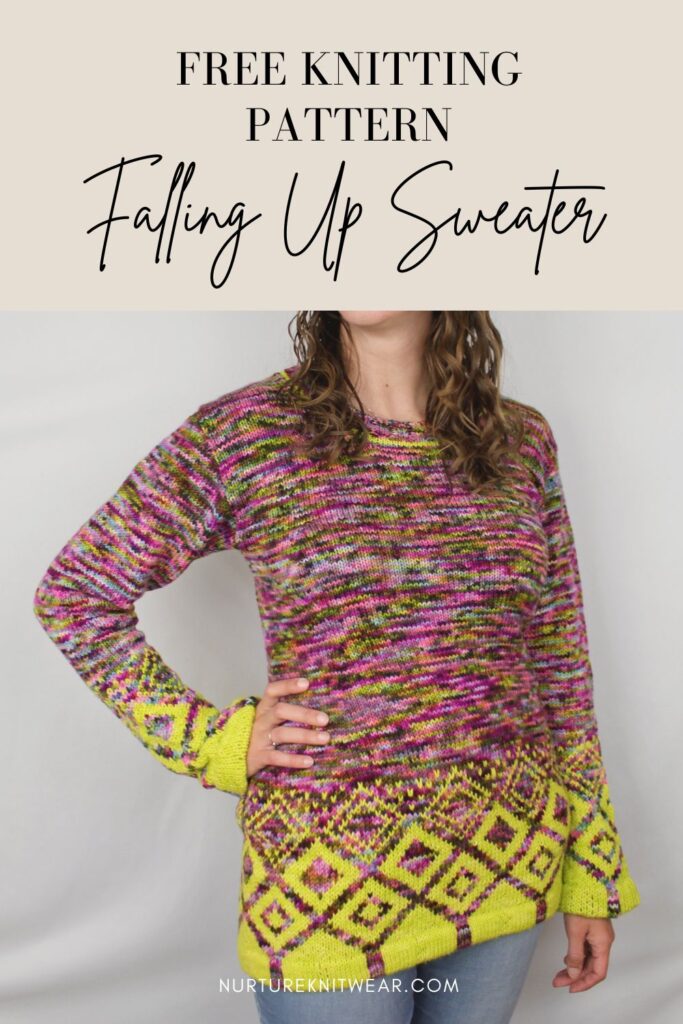
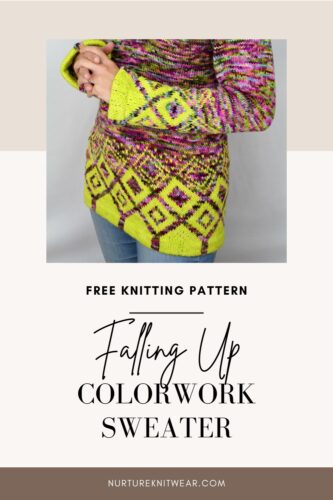
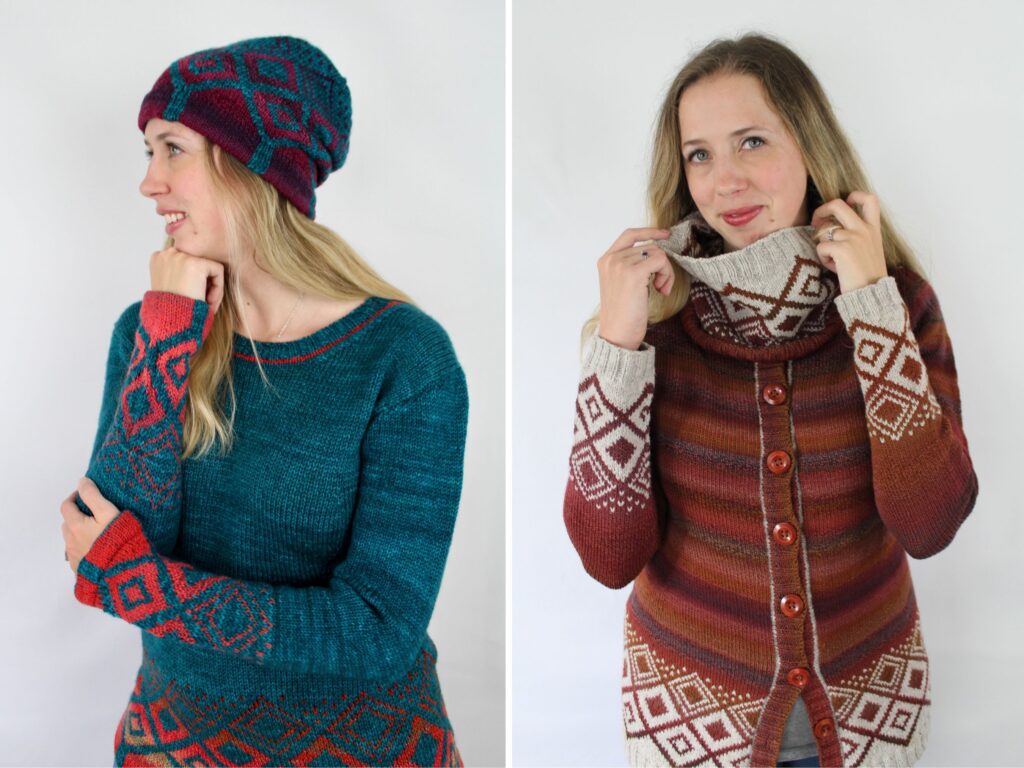
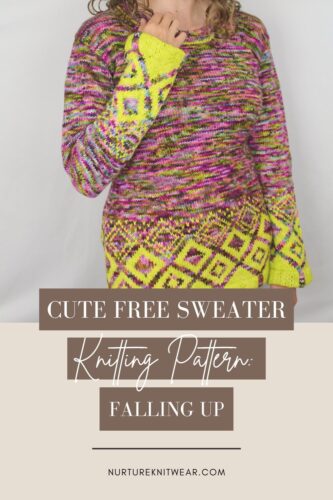
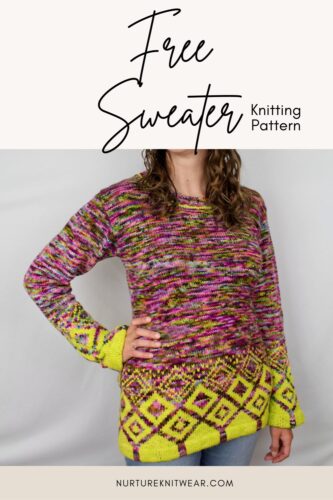
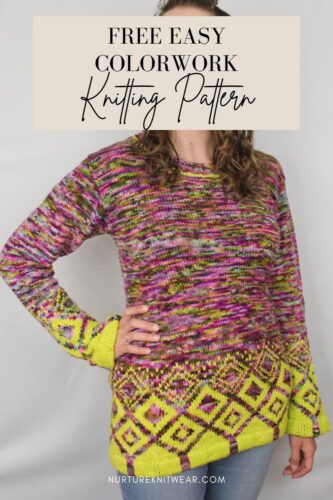
Stranded knitting is one of the skills most awed and most feared by new knitters. But letting that fear take hold can close you off to a world of amazing colorwork knitting patterns. So if you’ve been nervous to try, it’s time to bite the bullet and pick up your needles. So this free sweater knitting pattern is a how to guide for stranded knitting all on its own.
Here are 3 reasons why you should start your colorwork journey with Falling Up.
Yarn Support Note: I requested and received yarn support for this design, which means the yarn company provided the yarn at no cost to me. For a small independent designer, yarn support makes a huge difference—it helps offset the considerable cost of creating and publishing new patterns and allows me to keep bringing new designs to your needles. I’m so grateful to the yarn companies that choose to support my work!
1. Falling Up is Designed with Breaks So You Don’t Burn Out
I’m not going to lie, stranded knitting is not exactly a low-concentration knitting pattern. In fact, if you’re new to stranded knitting patterns, it will take more concentration than average. You’re learning to manage two strands of yarn and figuring out how and where to lock floats. And I don’t know about you, but that kind of concentrated knitting is only fun for a short time before I burn out.
So that’s why in Falling Up, a free sweater knitting pattern, the colorwork only lasts for 49 rows.
In this bottom-up pullover, a gorgeous provisional cast on hem allows you to begin with the colorwork, giving you a short space of concentrated knitting that’s just long enough to get comfortable with colorwork but not so long you get burned out.
Then you’ve earned yourself a nice long break of simple stockinette through the body and upper arms before it’s time to practice stranded knitting one last time on the cuffs to really solidify your new skill before binding off.
You’ll end with a gorgeous sweater and lots of well-earned confidence to tackle all the fabulous colorwork knitting patterns.
Thank you!
You have successfully joined our subscriber list.
2. Geometric Patterns Are Easier to Anticipate, Therefore Easier!
Another big reason why colorwork knitting patterns are avoided is that knitters don’t want to have to be attached to their chart at all times. Even a stranded knitting how to pattern might take too much concentration to watch your new favorite crime drama, but you should at least be able to listen to that podcast you’ve had in your “Up Next” list for the last 3 months.
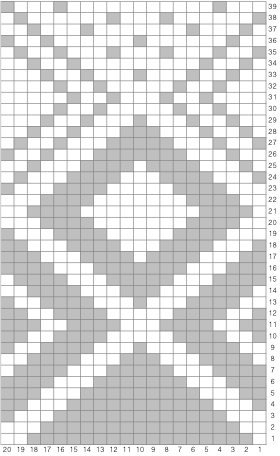
That’s why Falling Up features a geometric motif. You can easily see, based on what you’ve knit before, where you’re supposed to go. On each round, the diamond moves in or out by one stitch, meaning you don’t have to check your chart on each new round, giving you more time and headspace for the latest audio heartthrob.
3. Did I Mention It’s a FREE Sweater Knitting Pattern?
I mean, really what can be better than free? Keep scrolling down for the stitch-by-stitch instructions for the free sweater knitting pattern. Or if you prefer a printable (i.e. calming, well laid out, and ad-free) PDF, you can help support me and grab a copy for just a couple dollars on Ravelry or Etsy!
P.S. You Don’t Have to Start with the Sweater
Find starting with a whole sweater a little intimidating? No problem! Falling Up is one of a pair of colorwork knitting patterns. So begin instead with the Falling Up Hat! Hone your skills with this quick and easy stranded colorwork how to hat pattern, which can double as your colorwork gauge swatch so that you can begin with extra confidence.
Ready to dive into the sweater first? Then use up your scraps on the matching hat.
Either way, you’ve got a fabulous pair you can show off anywhere!
Your free pattern is on its way!
In the meantime, join in the conversation at Nurtured Knitters, our Facebook group! Ask questions, share photos, and join a community made to lift you up!
+ Get a HUGE Discount When You Get the Stranded Knitting Combo!
If you’ve hit the zone with DK weight Falling Up pullover and the Falling Up Hat, you don’t have to stop there! Get the whole Falling Up series, with the sport weight Falling Up Cardigan and Falling Up Cowl!
Experiment with different yarns and learn how different colors play with each other in this set of gorgeous colorwork knitting patterns.
Get 30% off when you buy all 4 on Ravelry or Etsy!
So my friend Sarah showed up at our LYS’s knit night with this stunning variegated yarn with pinks and greens and a bit of black. She was knitting a sweater. And every time she brought it in over the next several weeks, I fell a little bit more in love.
Of course, I asked her all about it and learned that it’s hand dyed by a local to Michigan dyer who goes by Supernova Dyeworks. The best part?
The colorway is named Swamp Monster in Love.
Finally, after weeks of drooling, I asked, “Would you be offended if I knit a sweater in the same color?”
Her answer? “I consider imitation to be the sincerest form of flattery. So I would be honored.”
Awww. And awesome!
I reached out Danna, the dyer behind Supernova; found Boy Math for my CC, and we got cooking!
I could not be more happy with the results.
Your free pattern is on its way!
In the meantime, join in the conversation at Nurtured Knitters, our Facebook group! Ask questions, share photos, and join a community made to lift you up!
The Knitty Gritty Details for the Free Sweater Knitting Pattern
MC – 690 (805, 910, 1035, 1160) [1300, 1430, 1575, 1695] yds/630 (740, 835, 950, 1060) [1190, 1310, 1440, 1550] m of DK weight yarn
CC – 250 (290, 330, 375, 420) [470, 515, 570, 615] yds/230 (265, 305, 345, 385) [430, 475, 525, 565] m of sport, DK, or worsted weight yarn
Suggested Yarn
MC – Magpie Fibers Swanky DK (80% superwash merino, 10% cashmere, 10% nylon) 250 yds/229 m, 115 g/4 oz – 3 (4, 4, 5, 5) [6, 6, 7, 7] skeins of Masquerade
CC – Spincycle Yarns Dyed in the Wool (100% superwashed American wool) 200 yds/ 185 m, 50 g/1.75 oz – 2 (2, 2, 2, 3) [3, 3, 3, 4] skeins of Stay Out of the Forest
Needles & Notions
All needles sizes will need 32”+/80+ cm circulars and DPNs or Magic Loop – preferred method of small circumference knitting
It’s high for the first 49 rounds of the body and the last 49 rounds of the sleeve, but in between the concentration level is as low as low can go with all stockinette!
Techniques to Indulge In
Stockinette in the round
Stranded colorwork
A provisional CO
Grafting stitches
Tubular BO (optional)
Short Rows
Your free pattern is on its way!
In the meantime, join in the conversation at Nurtured Knitters, our Facebook group! Ask questions, share photos, and join a community made to lift you up!
Free Pattern Glossary
BO – bind off (in pattern unless otherwise specified)
BOR– beginning of round
CO – cast on
dec’d – decreased
inc’d – increased
k – knit
k2tog – knit 2 sts together
LLI – left lifted increase – Using the left-hand needle, pick up the stitch below the stitch just knit on the right-hand needle. Knit the stitch.
m – marker
p – purl
pm – place marker
rep – repeat
RLI – right lifted increase – Using the right-hand needle, pick up the stitch below the next stitch on the left-hand needle and place it on the left-hand needle. Knit the stitch.
rm – remove marker
RS – right side or the side that will be seen when wearing
sm – slip marker
ssk – one at a time, slip the next 2 sts knitwise; return the sts to the left-hand needle, and knit them together through the back loops
WS – wrong side or the side that will not be seen when wearing
Special Techniques for the Free Pullover Knitting Pattern
Grafting Stitches – Pick up purl bumps along the WS of Round 39 with a spare needle (ndl) several sizes smaller (US 3 or 4). This will be referred to as Back Ndl. Needle with live sts will be referred to as Front Ndl. Fold the Front Ndl the WS and align with Back Ndl sts. With yarn cut to at least 4 times the circumference of sleeve, thread it onto a darning needle (DN). Taking to maintain an even, loose tension, begin this repeat: * Insert DN knitwise into first st of Back Ndl and slide st off Back Ndl. Insert DN knitwise into first st of Front Ndl and then purlwise into the first st on Back Ndl. Insert DN purlwise into first st of Front Ndl and slide off Front Ndl. Repeat from * to end.
Provisional CO – Creates a round of live stitches, secured by waste yarn or a cable. For a step-by-step written, photo, and video tutorial of how to create a Provisional CO four different ways, check out my blog post Ultimate Guide to Provisional Cast On: 4 Easy Methods at NurtureKnitwear.com.
Tubular BO – Slide a locking stitch marker into the first two stitches from left to right. Cut tail to 4 times the length of the BO area and place on a tapestry needle.
If the next stitch is a knit stitch: Slide needle into first stitch knitwise and pull off the needle; skip the second stitch; and slide the needle into the third stitch purlwise.
If the next stitch is a purl stitch: Slide the needle into the new first stitch purlwise; insert the needle between the second and third stitch from back to front; and slide the needle into the third stitch knitwise and pull through.
Repeat around. When you’ve reached the end. Place the first two stitches on the marker back on your needles to complete the last set. To see how it’s done, check out The Chilly Dog’s YouTube video Tubular Bind Off In the Round for k1, p1 Ribbing.
w&t – wrap & turn – On the knit side: hold yarn in back, slip the next st purlwise, bring the yarn forward as if to purl, slip the st back to the left needle, turn your work to begin purling. On the purl side: hold yarn in front, slip the next st purlwise, bring the yarn back as if to knit, slip the st back to the left needle, turn your work to begin knitting. To knit a stitch together with its wrap, slide your needle through the stitch and under the wrap to knit them together (making sure that the wrap loop always ends up on the purl side). To see all the wrap and knitted wrap possibilities, check out Very Pink Knits’ YouTube video Knitting Help – Slow Motion Wrap & Turn, Picking up Wraps.
For Rounds 9-19, you do not necessarily need to catch your floats as these will be tucked into the folded brim, but make sure that your floats are long enough so as not to pucker the fabric!
Beginning on Round 20 and for all the charted rounds, you’ll want to begin catching your floats every 3-5 sts to avoid catching and unnecessary wear and tear. Be sure to avoid catching the floats between the same stitches every round—doing so will result in seeing your floats poke through the front.
Get the Perfect Fit for Your Free Sweater Knitting Pattern
You can mix and match hips and bust size to get your perfect fit simply by changing the rate of waist shaping. I decided to match a Size 3 on the hips with a Size 2 on the bust because I kept trying it on as I knit (yes, you can do that with bottom-up too!) and that was most flattering for me.
Sleeve Length
Often need to change the sleeve length to get the perfect fit? No problem! Measure the height of your body motif and subtract that number from the sleeve length (see Schematic) to get the exact numbers you need.
Drop Sleeve Modification for Extra Ease
Maybe Drop Sleeve is your favorite style or maybe you’re not confident about turning a cap on your sleeve (You can do it! I believe in you!), either way, this sweater can easily be turned into a drop sleeve. After the underarm division, DO NOT knit the decrease section — Rows 1 & 2 or any repeats on the Front & Back. Keep in mind the stitch counts will no longer be accurate. Knit to the lengths recommended and DO the neck shaping. When you get to the sleeve section, pick up the number of stitches recommended and knit from there—see above to adjust length.
Your free pattern is on its way!
In the meantime, join in the conversation at Nurtured Knitters, our Facebook group! Ask questions, share photos, and join a community made to lift you up!
Falling Up: The Free Sweater Knitting Pattern
Hem
If your preferred provisional CO uses working yarn, use MC only. Any rounds worked with your MC will count as Round 1. If not, attach MC after provisional CO.
Using your preferred provisional CO and medium needles, CO 160 (180, 200, 220, 240) [260, 280, 300, 340] sts. Pm for BOR & join in the round.
Rounds 1-8, MC: K around.
Attach CC.
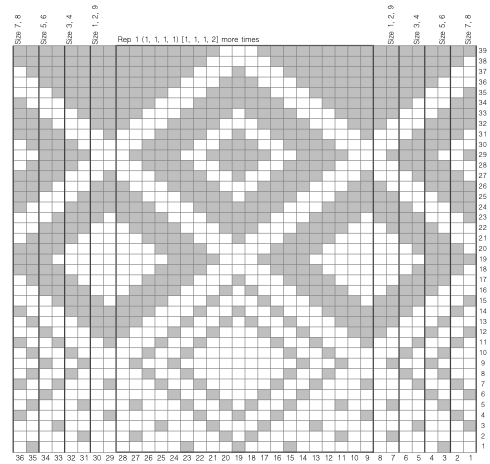
Rounds 9-19: Knit Round 1 of the Dissolving Diamonds chart 3 times using medium needles. Switch to large needles, and knit Round 1 eight more times.
Place provisional CO onto spare needles. Fold these stitches to the back of your working sts to create a tube of smooth stockinette.
Round 20: Knit the provisional CO sts together with your live sts while following Round 1 of the Dissolving Diamonds chart.
Knit Rounds 2-39 of the Falling Up Chart. Break CC.
Decrease Round: * K to m, sm, ssk, k to 2 sts before m, k2tog, sm, rep from * 1 more time, k to end – 156 (176, 196, 216, 236) [256, 276, 296, 336] sts.
Increase Round: * K to m, sm, LLI, k to 1 st before m, RLI, sm, rep from * 1 more time, k to end – 128 (148, 168, 188, 212) [232, 252, 272, 296] sts.
Repeat Increase Round every 0.5”/1.5 cm 5 (5, 5, 6, 5) [5, 5, 6, 5] more times – 148 (168, 188, 212, 232) [252, 272, 296, 316] sts.
Knit around until sweater reaches 19”/48 cm from the Hem.
Underarm Division
Set Up Round: K to 0 (1, 2, 3, 3) [4, 4, 5, 5] sts from the BOR (begin next round here).
Underarm Division: * BO 0 (2, 4, 6, 6) [8, 8, 10, 10], k74 (82, 90, 100, 110) [118, 128, 138, 148], rep from * 1 more time.
Place first 74 (82, 90, 100, 110) [118, 128, 138, 148] sts on a stitch holder or waste yarn. These sts will now be referred to as Front. The stitches remaining on the needles are Back.
Back of Free Sweater Knitting Pattern
Size 1 ONLY, skip to Row 3.
Row 1 (WS): P across.
Row 2 (RS): K2, ssk, k to last 4 sts, k2tog, k2 – 74 (80, 88, 98, 108) [116, 126, 136, 146] sts.
Repeat Rows 3 & 4 until the piece reaches 6.25 (6.75, 7.25, 7.75, 8.25) [8.75, 9.25, 9.75, 10.25]”/16 (17, 18.5, 19.5, 21) [22, 23.5, 25, 26] cm from the Underarm Division round, ending after completing a Row 3. BO all sts.
Front of Free Sweater Knitting Pattern
Attach yarn as if to begin a WS row.
Size 1 ONLY, skip to Row 3.
Row 1 (WS): P across.
Row 2 (RS): K2, ssk, k to last 4 sts, k2tog, k2 – 74 (80, 88, 98, 108) [116, 126, 136, 146] sts.
Place first 30 (32, 33, 36, 37) [38, 41, 44, 47] sts on a stitch holder or waste yarn. These sts will now be referred to as Right Shoulder. The stitches remaining on the needles are Left Shoulder. (Alternately, you can attach a second skein of yarn and work Right & Left at the same time.)
Left Shoulder (when facing)
Row 1 (WS): P across.
Row 2 (RS): K2, ssk, k across – 29 (31, 32, 35, 36) [37, 40, 43, 46] sts.
Repeat Rows One & Two 9 (10, 11, 12, 12) [13, 15, 16, 17] more times – 20 (21, 21, 23, 24) [24, 25, 27, 29] sts.
Row 3: P across.
Row 4: K across.
Repeat Rows 3 & 4 until the piece reaches 8.25 (8.75, 9.25, 9.75, 10.25) [10.75, 11.25, 11.75, 12.25]”/21 (22, 23.5, 25, 26) [27.5, 28.5, 30, 31] cm from from the Underarm Division round. BO all sts. Cut yarn, leaving a length 4 times the width of the shoulder for seaming.
Right Shoulder (when facing)
Attach yarn as if to begin a WS row.
Row 1 (WS): P across.
Row 2 (RS): K to last 4 sts, k2tog, k2 – 29 (31, 32, 35, 36) [37, 40, 43, 46] sts.
Repeat Rows One & Two 9 (10, 11, 12, 12) [13, 15, 16, 17] more times – 20 (21, 21, 23, 24) [24, 25, 27, 29] sts.
Row 3: P across.
Row 4: K across.
Repeat Rows 3 & 4 until the piece reaches 8.25 (8.75, 9.25, 9.75, 10.25) [10.75, 11.25, 11.75, 12.25]”/21 (22, 23.5, 25, 26) [27.5, 28.5, 30, 31] cm from from the Underarm Division round. BO all sts. Cut yarn, leaving a length 4 times the width of the shoulder for seaming.
Seam shoulders.
Your free pattern is on its way!
In the meantime, join in the conversation at Nurtured Knitters, our Facebook group! Ask questions, share photos, and join a community made to lift you up!
Sleeves (Make 2)
Attach MC in the middle of the armhole BO. Using medium needles, pick up and knit 70 (76, 82, 86, 92) [98, 102, 108, 112] sts evenly around the armhole. Pm for BOR and join in the round.
For short rows: Resolve all wraps as you come to them (see Glossary). For ease of knitting, mark wraps with an interlocking stitch marker in the stitch below so that you do not have count and or track stitches.
Short Row 3: K to 2 sts past the previous w&t, w&t.
Short Row 4: P to 2 sts past the previous w&t, w&t.
Repeat Short Rows Three & Four 8 (9, 10, 10, 11) [12, 13, 14, 14] more times. K around to BOR and then k around one additional time.
Decrease Round: K1, ssk, k to last 3 sts, k2tog, k1 – 68 (74, 80, 84, 90) [96, 100, 106, 110] sts.
Repeat Decrease Round every 0.75 (0.75, 0.5, 0.5, 0.5) [0.5, 0.5, 0.5, 0.5]”/2 (2, 1.5, 1.5, 1.5) [1.5, 1.5, 1.5, 1.5] cm for an additional 12 (15, 16, 18, 19) [22, 22, 25, 23] times – 44 (44, 48, 48, 52) [52, 56, 56, 64] sts. Knit around 1 time after final decrease or until sleeve reaches 11 (11.5, 11.5, 12, 12) [12.5, 12.5, 13, 13]”/28 (29, 29, 30.5, 30.5) [32, 32, 33, 33} cm. Switch to large needles.
Attach CC. Work Sleeve Motif Chart (see next page) from your size’s start line, completing the center repeat the specified number of times, and ending on your size’s end line. For example, Size 8 will start on st 7 and work sts 7-10, then work the center repeat (sts 11-30) a total of 3 times, and then work sts 31-34. Switch to medium needles on Round 24.
Place an interlocking stitch marker on the first Round 39. (Note: I recommend running a lifeline the first time you knit Round 39. It can be a bit tricky to find this row behind all the floats for your grafting. Having a guideline of the lifeline is super helpful!)
Repeat Round 39 eight more times. Cut CC. Switch to small needles. Work 6 rounds in stockinette. Cut yarn with a length of 4 times the circumference of your sleeve. Using the stitch marker as a guide, graft the live stitches to the first repeat of Round 39. Refer to Grafting Stitches in Special Techniques.
Collar
Starting at the center back of the neck opening, using small needle and MC, pick up and knit 96 (100, 108, 120, 124) [128, 140, 148, 160] sts. Switch to medium needle. Attach CC, do not cut MC.
Rounds 1-2: With CC, knit around.
Cut CC, pick up MC. Switch to small needle.
Round 3: K around.
Round 4-10: * K2, p2, rep from * around.
Cut yarn with a length of 4 times the circumference of your collar. BO in patt using Tubular BO (or your preferred stretchy BO method).
Finishing the Free Sweater Knitting Pattern
Weave in ends.
Wet block sweater in as warm a water as your yarn/colors will allow. This allows the color work stitches to shimmy into place, even out, and bloom to fill in any gaps.
If you share photos of your Nurture Knitwear projects, please be sure to tag me @nurtureknitwear and use the hashtags #nurtureknitwear and #fallinguppullover.
What Are You Waiting For?
There’s no need to fear stranded colorwork. You can do it! All you need to do is grab the pattern, pick up your needles and try. What’s holding you back?